

This post may contain affiliate links. Please see our disclosure policy for more details.
Earlier this week, I learned a mind-opening truth about organic products and whether or not pesticides cause damage to our health.
First of all, let me just start by saying that what I’m about to share with you may open up a can of worms for some of you, as you may already have strong opinions and have made up your minds in regards to this matter. However, I feel it is important for me to share the most recent data and findings.
As I’m sure you’re aware, there are many, no. an endless number of websites, blogs, and other informational sources out there presenting the case of how detrimental pesticides are to our health and how we MUST purchase organic foods. I’ve read many of them, and I will say that the information that is out there really persuaded me into purchasing ONLY organic produce.
However, what we (although I’m not quite there yet), the RDs, strongly believe and focus on is helping people make informed decisions. There are so many websites out there that deal with nutrition, and it seems as though everyone’s an expert. Now, this is not a competition, but I will say that you really need to pay close attention to your sources so that you can make informed decisions.
Here’s a list (not exhaustive) of websites we’ve been taught to never use as sources for our research papers and class assignments as there is very limited sound scientific evidence behind their information:
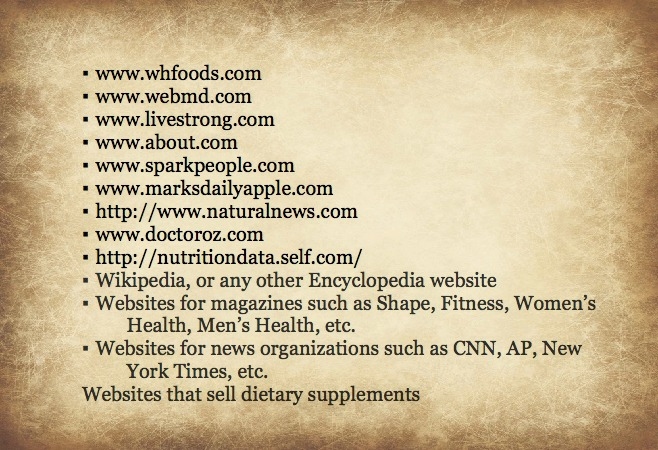
Do you refer to any of these sources to guide you in your decision-making when it comes to diet and health? Umm..Dr. Oz, anyone? I personally rely a lot on livestrong.com so this was a shocker.
So…you’ve heard how pesticides can cause all sorts of harmful effects on your body. Many studies are quoted as supporting-evidence. However, oftentimes the facts are blown way out of proportion or it may be that there were flaws in the study design when you take a closer look. That’s another major fact that we learn in school: not all research designs are created equal.
Here’s what we know is true. First of all, who regulates pesticides? It’s a combination of three agencies, the EPA, FDA, and USDA. The USDA Pesticide Data Program’s (PDP) main purpose is to measure the pesticide residue levels in food. Every year, hundreds of pesticides and their metabolites in produce, grains, meat, and dairy products are measured across the country with samples from over 100 different commodities for over 500 different pesticides.
Now this is a really lengthy and overwhelming website, but I encourage you to take a look. If you scroll down to Appendix B, towards the very end, it lists all the fruits and vegetables, the number of samples, % of samples with pesticide residues, range of values detected, and EPA tolerance levels (maximum residue limits set by the EPA that ensure safety) for all the different pesticides used. You can see that residues were not even detected in most of the produce. And we’re talking out of hundreds of samples here. And if the residue numbers are high, such as in cilantro and bell peppers, their values still don’t even come close to the EPA tolerance level.
So then, what about washing? Does it eliminate these pesticide residues? As you know, supermarkets do not wash the produce before putting it out. However, we’ve all been attacked by the spraying mist that never fails to go off when you’re trying to reach in. Well, they’re not there just to spray you unexpectantly. In fact, it’s been found that 99% of the residues are washed off at the packaging house by the food processor – for instance, 83% of the residues found on fresh apples were removed during processing into applesauce and 98% of residues from oranges processed to orange juice were removed. (source).
Still concerned? Ok. Then here’s the deal. There are so many organic labels out there, wouldn’t you agree?

However, the only label that is of any value is this one…
 So what are your thoughts? I know this is a lot to chew on, but I will say again that I was very surprised by these facts. Our professor concluded by saying that if you’re purchasing organic foods purely because of the possible health risks, you shouldn’t be overly concerned. No need to pay double the price of conventional ones. However, for infants and toddlers, it’s recommended to feed them organic products as their immune systems are not fully developed at that stage. Now if your concern is more due to the environmental issues, then that’s a whole other issue. Also, nutritionally, there’s absolutely no difference!
The choice is up to you, of course. But let me leave you with these two lists:


So to answer the question – organic food, yay or nay?
For me, if money wasn’t an issue, I would still continue to get organic foods. Even though research shows that the amount of pesticides is not even close to the harmful range, I am an extremely paranoid person as well as a purist. I don’t want anything that’s unnatural. Having said that, there are also contaminants in organic foods left behind from dirt, insects, food handling, transportation, etc. So remember to wash, wash, wash.
However, as Tim and I are really tightening our wallets, I’m no longer going to be organic obsessed..this only means that I’ll be moving onto something else to be obsessed about. 😉
When it comes down to it, conventional or organic, the most important takeaway is to consume more fruits and veggies. Don’t sweat it if you can’t purchase organic foods all the time, and please please don’t let that deter you from consuming these phytonutrients!
Questions:
– Did any of this information surprise you?
– Organic food, yay or nay?





This is a great post, Min! Thank you for taking on the issue from a scientific perspective, and educating us about reliable sources 🙂 It’s so crazy how many unreliable sources there are out there…we run into that problem with medical advice as well. I guess my take-away is that if we can afford it, I should try to buy organic from the dirty 13 list, especially if we are going to be feeding it to the kids.
I hope you’ve had a relaxing and productive weekend, Min! Praying that you are recharged and rejuvenated to take on a new week 🙂
What a great post!
I haven’t been as many organic foods due to cost but normally buy organic from the dirty dozen list. This is a truly intriguing argument. As you see, it makes me a little less worried!
Love this post Min! Thanks for sharing all you are learning and I can’t wait to read more on this from what you linked. I definitely agree, if I had the money I’d buy more organic. For now I just like to clean my produce because of all the bacteria and such from people touching it 🙂
I’ve started trying to buy more organic when I can, especially for the “dirty dozen” things. It’s hard because organic can be expensive but I think it’s worth it to make trade offs in other areas!
Wow, the list of websites not to use is really surprising! I have always relied on whfoods and Self’s nutrition site, but I’ll have to verify any information coming from there elsewhere in the future. Super informative post!
Thank you so much for this post Min, it was so well researched and written in a clear way. I loved the ‘dirty’ and ‘clean’ foods – an easy way to work out what you should buy organic. My thoughts are that I will try to buy anything that I eat the natural packaging (the skin) of organic – berries, spinach, apples etc – and those that I cut the skin off or that grow underground – potatoes, avocado, kiwi – I buy non-organic. But sometimes it is just not that simple, especially financially.
Thank you for reading! Like you, I’m still going to purchase organic apples, berries, peaches, but I’m not going to sweat it if I can’t all the time. It’s better to eat them then to avoid just because they’re not organic 😉
I adore these posts of yours Min 🙂 I find it really frustrating when people believe articles written by people with no qualifications and with reference to no actual data (or to data that aren’t very trustworthy!) and then get on a soap box and insist their view is “right”. I am accepting of differences in opinion but wish people would realise that not all sources of information are equal!
I use Wikipedia a lot for ‘casual’ topics, like looking up a city I hadn’t heard of or whatever, but definitely wouldn’t rely on it for important information. Your links here are fantastic and I didn’t know all of what you’ve jotted down – but did know some of the claims about organic food being necessary are inflated! I try to buy local produce and then don’t worry so much about if it’s organic or not, because I know it is farmed and produced on a local small scale. I do still prefer organic strawberries mind you – but the rest I’m happy to go with standard because I don’t have endless money either 😉
Aww..thank you, Kari. Seriously, there are soo many misinformation out there..and it is extremely frustrating! Please back it up with valid scientific evidence, people! Anyway, you’re absolutely right! I love to go to farmer’s market, although I haven’t been going as frequently as I’d like to.
i’m with you: if money weren’t an issue, i’d do organic 100%. but since money IS an issue, i try and do organic apples since they’re on the dirty list and i eat them so frequently.
Oh yes! organic apples are a must for me as well..along with berries and peaches.
Hi Min! Cool post…it’d be interesting to know the EPA tolerance level. I’m not sure what or how it measures pesticide levels, but personally, I don’t want to be eating any!! I understand something like watermelon or avocado probably wouldn’t be as dangerous as celery or apples, and thus, there is no need to buy a $4 a pound watermelon, but thin-skinned fruit and veggies are an organic must for me!
I feel ya. Even though we learned that the pesticide levels are no way near the toxicity level, I’m still wary. However, I’m not as obsessed, though. Def apples, berries, and peaches I’m going to get organic.
Wow I’m surprised to see whfoods.com on the list! I always thought the site’s info was credible. This post was really informative, Min. As health-conscious as I am, organic food is not a priority of mine. Obviously it’s preferable but it’s not a big deal if only regular options are available. My only requirement for organic is cows’ milk: my hormones are already out of whack so last thing I need is to deal with the hormones pumped into cows!
Oh yes, I’m with you! rBST injected cow milk? No thank you! And it’s so sad because the cows actually get mastitis from it…terrible..